
MyHiringOptions state guide: Michigan
Michigan employers: the 20-day new-hire report
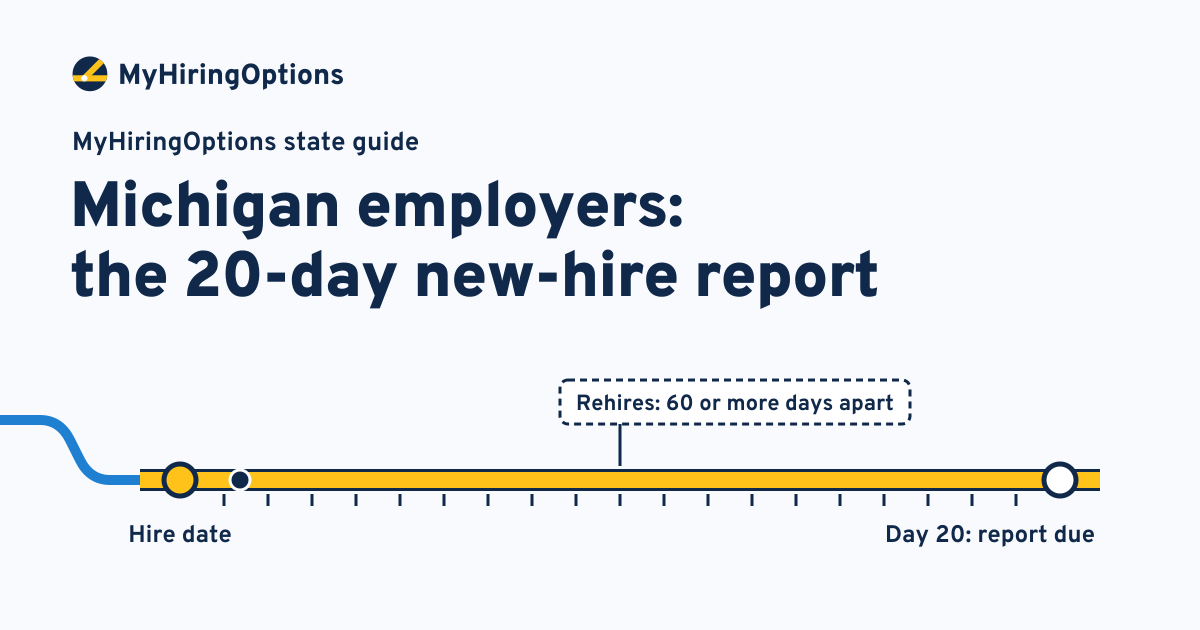
Michigan's new-hire report is short, but it is strict about completeness. Here is what it asks for and how to keep it from stalling between the hire and the office.
The rule in Michigan
The State of Michigan New Hire Reporting Form (Treasury form 3281, revised 2026) says reports must be submitted within 20 days of hire date, meaning the date services are first performed for pay. Reports go to the Michigan New Hire Operations Center; online reporting is at mi-newhire.com, and the center's phone number is (800) 524-9846.
Federal law sets the outer limit: an employer must report each new hire to the state directory of new hires no later than 20 days after the hire, and employers that report electronically may instead send two transmissions a month, 12 to 16 days apart. The report carries the employee's name, address and Social Security number, the date they first worked for pay, and the employer's name, address and federal tax identification number (42 U.S.C. 653a).
New hires and rehires
The form defines a newly hired employee as someone not previously employed by you, and a rehired employee as someone who worked for you before but was separated from employment for at least 60 consecutive days. Both are reported.
Complete or rejected
Michigan's form is direct about this: reports missing mandatory information will be rejected, and you must correct and resubmit them. The mandatory fields are the employee's Social Security number, name, address and hire date, and the employer's federal employer identification number, name and address. A rejected report still has the same deadline, so gather those details at the hire, not later.
Employers in more than one state
If you report electronically and have employees in two or more states, the form notes you may register as a multistate employer and send all new-hire reports to one state.
Where it slips, and how to keep it on track
Missing fields are the Michigan-specific risk: an address or Social Security number that never made it from the candidate to the office turns into a rejected report.
The report itself is filed by whoever runs your payroll or onboarding. Where a hiring workflow helps is the hand-off: when your team marks a candidate as hired, the workflow can remind the person who files the report, with the hire date and the deadline, so the 20 days are not lost between the hiring manager and the office. Your team still decides who is hired and files the report.
Before you rely on this guide
This is a plain-English summary, not legal advice. Check the current Michigan New Hire Reporting Form and mi-newhire.com for filing options before your next hire.