
MyHiringOptions blog
Why candidates go quiet, and how to keep them moving
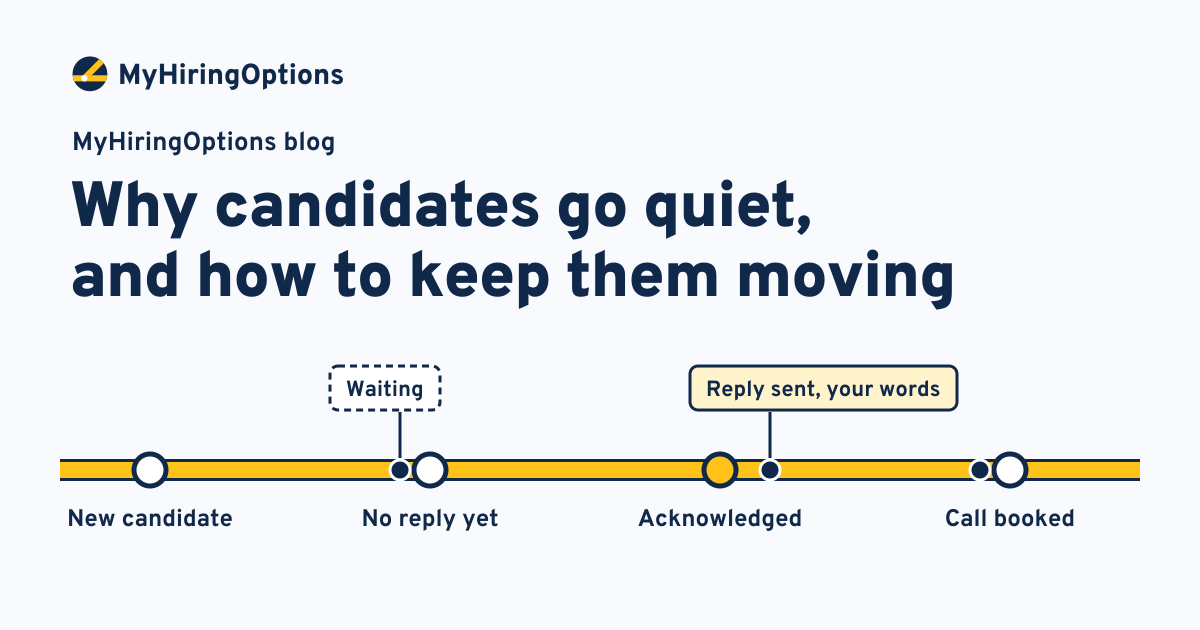
You found a good candidate on Monday. By Thursday they have stopped answering. It is tempting to call it ghosting and move on, but most of the time the quiet starts on our side of the table: a reply that never went out, a step that took a week, a scheduling thread that ran out of patience.
That matters more than it used to. In September 2026, 87% of small businesses that were hiring or trying to hire reported few or no qualified applicants (NFIB). The median time to fill a nonexecutive role in 2026 was 39 days (SHRM). When good applicants are scarce and the process is already long, every candidate who drifts away costs you another round.
The silence goes both ways
Candidates feel it too. In a vendor survey of 2,500 job seekers in the US, UK and Germany, 61% said they had been ghosted after an interview (Greenhouse, an applicant tracking vendor, December 2024). Treat that as a signal rather than a precise measure, but the direction is clear: people expect to wait, and many of them decide not to.
They also have options. The Bureau of Labor Statistics counted about 5.2 million hires and 7.1 million job openings across the US in August 2026 (JOLTS, preliminary). A candidate who hears nothing from you for a week has probably heard from someone else.
Why candidates go quiet
When we sketch a hiring line with an employer, the stalls tend to sit in the same few places.
- No acknowledgement. The candidate sends their details and hears nothing. They cannot tell whether a person ever saw it, so they keep looking.
- Long gaps between steps. Each step may take a day, but the wait between steps takes a week, because nobody owns the hand-off.
- Booking friction. "When are you free?" turns into five messages. In a vendor survey of 12,000 candidates in seven countries, 31% said their first interview took two to three weeks to schedule (Cronofy, a scheduling software vendor, 2024).
- No clear next step. The conversation ends with "we will be in touch". The candidate does not know whether that means tomorrow or never.
- Too many channels. The first contact came through a job-board inbox, the follow-up by text, the interview invite by email. Messages get lost between them, on both sides.
- A faster offer elsewhere. Sometimes nothing went wrong except time.
Only the last one is truly out of your hands, and even that one gets rarer when the first five are fixed.
Six habits that keep candidates moving
1. Acknowledge every candidate the same day
A short, honest message is enough: we have your details, here is what happens next, here is roughly when. Write it once, in your own words, and send it to everyone. If the message is automated, say so. Candidates do not mind a template; they mind silence.
2. Always name the next step and a time
End every contact with what happens next and when. "We will call you to set up a short phone conversation by Wednesday" is a promise you can keep and a candidate can plan around. If the date slips, send a one-line update before it passes.
3. Set a waiting limit for every stop
Decide how long a candidate may sit at each stop before someone on your team is reminded: perhaps one working day after a new candidate arrives, two days after a phone conversation. The point is not speed for its own sake. It is that nobody waits by accident.
4. Let candidates book their own times
Instead of trading messages, send a link to the openings you have already set aside. People working shifts can pick a slot at midnight if that is when they see the message. Reminders before the call cut no-shows on both sides. (Our guide to interview scheduling without the back-and-forth covers the set-up in detail.)
5. Keep one status that everyone can see
A candidate stalls when two people each think the other one called back. One current status per candidate, with the name of the person who owns the next step, ends that. It can live in your applicant tracking system, a shared sheet or a workflow; what matters is that there is only one.
6. Close the loop yourselves
When the answer is no, say so, kindly and promptly. Decline messages are a decision, so they come from a person on your team. A clear no today keeps your name good with the next candidate, who may well know this one.
What to automate, and what to keep
Most of the habits above are coordination, not judgement, which makes them good candidates for automation: collecting new candidates from every inbox into one list, sending the acknowledgement you wrote, reminding your team when a waiting limit passes, offering interview times and keeping the status current.
The judgement stays with people. Your team reads every candidate, chooses who moves forward, runs every conversation and makes every hiring decision. A workflow should make the chasing disappear, not the people.
A quick check for your own hiring line
- Does every new candidate get a reply the same day, from any channel?
- Does every message end with a named next step and a time?
- Do you know, today, which candidates have waited longest and who owns their next step?
- Can a candidate book a time without trading messages?
- Does every candidate hear a final answer from a person?
If two or more answers are "not really", that is where your candidates are going quiet. Pick the stop that hurts most and fix that one first.